

Friday, January 31, 2014


Thursday, January 30, 2014
The Kirsten Dunst Connection: How Character and Face can Alter Feeling.

And this is not about idolization; no, all my idols are dead. It just seems that at most every point of Dunst's career, she was playing, in that exact moment, a part of me.

1999's The Virgin Suicides was seriously, the best film I had ever seen. At the time, I was sixteen. I was a projectionist in a movie theater; I had just transferred schools, and I only talked to the most untrustworthy people because I just wanted to be alone. In the projection booth, I would chain smoke out the back door, on the third floor, and watch the lights shifting along the expressway. I stayed in the dark rooms alone, all night, laying across the velvet cushions that covered the concrete floor, their only function as fractured movie seats. I wrote, nonstop—I wrote love letters, poems, I wrote everything, and most of it I did not mean.

Coppola's film felt like me. The golden light, the sound of strings and longing. The plucked cords, the old newspapers stacked high, keeping the house behind a screen— the feeling of always looking at the world through glass, as something that kept moving beyond me, felt like things that were true. And there were other things.
That year I went to Homecoming at a factory that was decorated like a rain forest, a carnival; parts were decorated like Halloween, and we dropped acid, and I sat on a bench all night talking to a stranger, in Santa's North Pole, laughing at the audacity of Santa Claus and what he has gotten away with for so long. That Homecoming too, I started the night at a Chinese restaurant, with a blonde boyfriend, and at some part of the night, I ended up with a dark haired one that liked music, and to have fun and laugh at everything.

I could write about Torrance in Bring It On (2000) and my long term stint as a competitive cheerleader, or how Nicole in Crazy / Beautiful (2001) and Mary in Eternal Sunshine of the Spotless Mind (2004) represent absolute pieces of my psyche and personal history and lunacy and sense of longing, but mostly, at this point, Kirsten Dunst was still on an upswing, and her film choices were frequent and diligent. Her characters swayed between strength and fragility, which most teenagers and girls in their early 20s feel, so


I saw Marie Antoinette (2006) three times the first weekend it came out, and each time it was with someone else. Despite the intricacies of sound and silence; the brightness of light and scene versus the weary, fading feeling of becoming a shadow; the longing to see the world outside of the same glass frames that were present in The Virgin Suicides, but more refined, more designed and put together, all framed something very much the same in my life. The dreariness of Dunst's Antoinette when she was alone, completely a stranger to her new family, resonated with me. It was the dissolution of the self in order to fabricate something new for everyone else, and even still, that was not fine enough, but Marie Antoinette, despite the cultural shift it caused, was pretty much panned and pulled through the streets, ravaged entirely.

There was Dunst's Lolita photo shoot in Lula Magazine, which hit stands when I was obsessed with Nabakov, and talking to Vincent Gallo, quite frequently, about similar things;

then the "Non Plus One" film for the fashion house, Opening Ceremony, which she made with Jason Schwartzman, which I saw in my little, yellow apartment in Omaha, and I so badly wanted my relationship to reflect the same thing.
Katie Marks' in All Good Things (2010) exemplified the worst part of making the worst mistake and disappearing completely, and Dunst's Justine in Melancholia was one of the greatest, most beautiful apocalyptic dramas that I have ever seen, and her role in the film was almost as beautiful as the ultimate tragedy— the great finality of life— no literature, no trees, which Justine was acquainted with, already, so intimately. But even that film had a terrible run and limited release because Lars Von Trier said some pretty horrible things and was pulled from Cannes for his personal beliefs.

There is art and characters and print and film that are created at points in history, which connect so seamlessly to our universal subconsciousness, and seem as if they were always meant to be. Then there are names and faces, hair colors and dispositions, the universality of personal experience that can so easily be played out on the screen, and seem so similar in their expectancies, their heartaches and beliefs.
Wednesday, January 29, 2014
Raymond Carver and the Nature of America’s Romance with Material Things.

As far as
American authors go, Raymond Carver is hardly ever referenced beyond his
influence over young writers, which could, very much, be seen as something
terribly derogatory. However, the conversation of Carver’s work extends much
farther than the exclusion of his universal significance and appeal.
Unfortunately
for Carver, our culture does not take the art of poetry and short story writing
very seriously, and he just so happened to only write in those two veins. As
dead and remembered, he is revered by other authors for his dedication to these
minimal arts, but it is these arts that reduced his readership and his authenticity
as a serious writer because mostly, only other short story writers and poets
read short story writers and poets.
Carver
wrote a handful of books in his life, and one after his death. All of these
books followed the minimalist structure—the idea of creating dramatically
impacted brevity—the idea of Hemingway’s “Iceberg Theory” where only absolute and
concrete details are visible on the surface; all the emotion, morals, thoughts
and sentiment are hidden below the sea and must be inferred.
A lot of
readers think that is lazy, allowing the reader to dictate the sentiments and
feelings. It worked for Hemingway because Hemingway was an adventurer; his
stories were about wild places and wild things and wild people that could
handle their surroundings—
but this
is not what Carver aimed to be. His stories revolve around the dissolution of
the American dream. His constant question seems to be: what happens when you attain everything you’re taught to want? His
themes did not circle around the actuality of segregation and the dissolution
of the American Nuclear Family; his stories were dead set on the absolute
impact of these negative American structures.
The
problem, for Carver, was audience. He wrote and published between the
1960s-1980s, a time span when Americans did not want to readily accept the
faults and shortcomings of the world they created.
We are a
culture that thrives on the idea that if you throw enough money at a problem,
the problem will go away, but when the problem still exists, we are faced with
our inadequacies, and that is something we just have a difficult time
believing.
The misfit
we can accept: the misfit is a wanderer, the man in the black hat—he is the
idea. But the actuality that the American
Everyman is simply a wanton and fractured thing, full of fantasies and
dreary beliefs, could never be true.
And keep
in mind, Carver is a minimalist, which means that the sentiments around these
actions are completely up to the reader—a reader that could not accept this
reality.
And the
reality is, we want the ones we can’t
have. Two of his more popular, but impossible to find stories, “Neighbors”
and “Are These Actual Miles?” maintain the theme of a world that is not so
easily attained, and when the accruement of modern things have reached their
peak, the characters are left facing their fractured relationships,
relationships that center around marrying the wrong person, about searching for
the fantasy, about cheating and leaving in order to find the next good thing.
Maybe if
we could have been open to these realities—even in fiction—the constant up and
down crises that have occurred from the 1980s until now could have been more
steadily marked, more easily avoided. Maybe more of us could have married the
right people, and not define our lives by the romance of the things we have
collected but are still paying for, everyday, which is truly the ball and
chain.
Tuesday, January 28, 2014
A Review of Z: a Novel of Zelda Fitzgerald &How Female Writers &Historians are Making Feminist Heros Out of Remembered Villains.

When I first began studying literature, the two most profound concepts that I became obsessed with are as follows:
one. Czeslaw Milosz's idea that the purpose of a writer is to create a space for the dead.
two. Jorge Luis Borge's insistence that everything is fiction.
Each point is not only sound, but productive for both the writer and the readers; however, these opposing ideas insist, together, that one must always, always question the reliability of the narrator, which is why, when it comes to historical tomes about women— women that were misrepresented and mislaid out in history— I always question the goal of the narrator.
Furthermore, in recent years, it seems that numerous other women feel this way too, which is why it seems that so many female writers and historians fall back into those tomes and letters and histories to unveil the truth; and these volumes do not go unnoticed. For example, Antonia Fraser's 2001 biography, Marie Antoinette: the Journey, not only permanently disassociated Antoinette from the moniker of a self righteous queen with a "Let the eat cake!" mentality, but Fraser also disassociated Antoinette from the cause of the French Revolution completely, turning Antoinette into a scapegoat. Fraser's biography was not only a national best seller and on numerous Book-of-the-Year lists, but she caused an entire resurgence of art, fashion, literature and film that all focused on Marie Antoinette, the front runner being Sofia Coppola's 2006 film, Marie Antoinette, which Coppola wrote the screenplay for that was created from Fraser's biography.
Likewise, Therese Ann Fowler's 2013 biographical fiction, Z: A Novel of Zelda Fitzgerald, carries the same weight that a new manifesto of an old figure needs; however, Fowler needed to cut through a tremendous bit of rumor and memory before she could even get to the heart of the Zelda Fitzgerald's story.

In American literature, Zelda Fitzgerald is remembered much in the way of Marie Antionette, as Zelda Fitzgerald is seen as the guiding force of her famous husband's, F. Scott Fitzgerald's, inability to write, absolutely ability to drink, and ultimately, his untimely death. She is associated to a world of torment for her husband; however, most of these accounts come from F. Scott Fitzgerald, somewhat, through numerous novels, which he credits lifting completely from Zelda herself and her journals, and Ernest Hemingway, who was not only a famous drunkard himself, but most of his knowledge was based off of his nights out with F. Scott, where the complaining came between the party. Not to mention, F. Scott was at his peak of popularity when he brought Hemingway into the literary circle by endorsing Hemingway's novel and sending the copy to his publisher, which soon became Hemingway's publisher, and sent Hemingway into literary stardom.

If there is anything that has occurred throughout history, it's the literary boys' club, and Fitzgerald and Hemingway were established members. Besides their drinking, the only thing these two men couldn't control was Zelda herself, which Fowler proves. The Roaring 20s and Flapper Movement were not only built around prohibition, but the women involved in the movement themselves: the rebellious, partying, intelligent, take-no-prisoners flappers, which Zelda had invented. Furthermore, she maintained her status as the figurehead, and it is virtually impossible to topple a figurehead; one can only chip away at it. And throughout history, Zelda is known for these parts that have broken away and defined her, which was mostly found in Hemingway's 1964 autobiography, A Moveable Feast, which Fowler all but toppled herself.

If Zelda Fitzgerald's status as a feminist figure has ever been questioned, Fowler moves Zelda Fitzgerald's relevance into sharp focus because she moves past Zelda's emblem as a party girl, and focuses more than half the tome on who Zelda became after giving birth to her daughter, Scotty. In a culture that defines motherhood as the end-all-be-all of coolness and sexuality, Fowler proves that Zelda became even moreso in her own right.
While F. Scott sunk deeper and deeper into alcoholism and depression, Zelda became a writer, a ballerina and a painter. However, there are things the movement could not do, and most of Zelda's stories were published under F. Scott's name, not only because F. Scott was paid a higher sum, but also because he saw it as embarrassing that Zelda was publishing when he could not write a thing.

More so, as a ballerina in Paris, Zelda was not only dedicated to ballet, but she shined, and she was offered a position with a ballet company in Italy, which F. Scott refused to let her take, and instead, Zelda was sent to a sanatorium for months on end, and mostly, she was there because F. Scott saw her as uncontrollable, and Zelda saw her life as unlived. It was in the sanatorium that Zelda took up painting.
Fowler's Z: A Novel of Zelda Fitzgerald builds a new manifesto to the memory of Zelda Fitzgerald. Not only is the story itself intriguing, but the language and descriptions create a sense of being steeped in reality, and that sense of reality is why the book is classified as a historical fiction, despite the years of research. And though Fowler discredits F. Scott Fitzgerald's and Hemingway's accounts, she still gives parts of them relevance, and she brings all the negative to light, which not only creates a place for the dead, but questions the relevance of truth in history and memory.
Monday, January 27, 2014
langston's bedroom full of moveable and tactile things.

when I think about the way a baby's room should be, there are very few, but very absolute, words that come to mind: airy, light, tactile, clean and full of wonder.
when I was a baby, my bedroom was not really a bedroom at all. my tiny room was in this strange, makeshift space that was in my parents' bedroom, that was a closet I think, then it became my mom's sewing room, and then it was turned into a bathroom. but as my baby bedroom, my parents decorated the space in green and yellow because they did not know if I was going to be a young miss or a small suitor, either way, I turned out to be a very happy baby, and also, I am very into the idea of gender neutral rooms.
so for langston's room, my color palate is fairly easy: spring green, blue bird blue, light yellow and orange, and some shades in between. I wanted the furniture to be dark wood and versatile because I wanted to keep the walls cream. we live in a place with a tremendous bit of gardens and large oak trees, so not only did I want to bring the natural world in, but I wanted the room to have great daylight even though there are so many shade trees.
tactility was also on the list. hence the grass green shag rug. also, my mom made the giraffe curtain, which is three d. the giraffe has eyelashes and a mane; it also has ears and a tail that move. mostly, the giraffe is made out of polar fleece, which is so incredibly soft, and the hooves and things are made from faux leather. the other curtain (which she is still making) is an elephant. she is also making three, three d animals (a giraffe, momma elephant and baby elephant) that attach to the walls, and will appear as if they are walking around the room. the wall giraffe is easily four feet tall, and he is going to be bending into the crib,
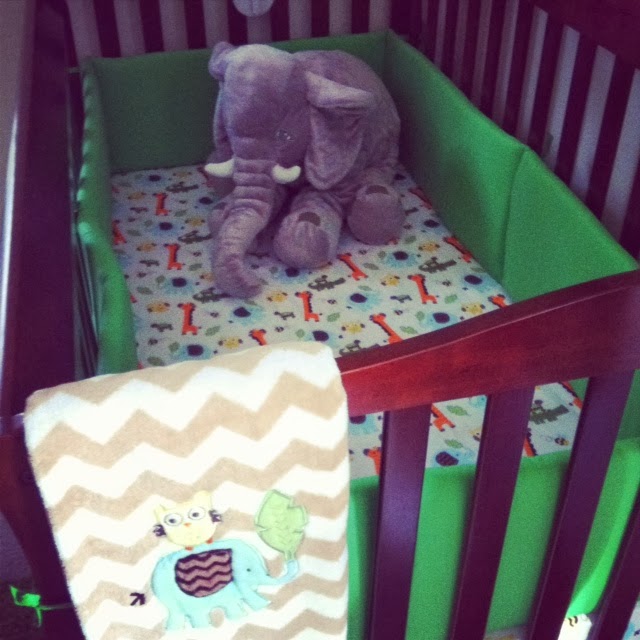
which my mom also made the spring green bumpers for. I wanted the crib to look like the feeding pens at the zoo: wood crates full of grass and things. I know this concept will be lost on Langston, but I like to imagine things, and I like to bend the world as much as I can to suit my imagination, which is why I love design and aesthetics so much.

over the crib is a mobile, of course, and on the wall are two mounted stuffed animal heads, which I special ordered from my friend, Alicia, that owns Deerly Departed. She is still working on the elephant, which will hang over the zebra. it kind of goes without saying that along with tactility, I wanted Langston's room to be full of homemade things because objects made with love and care can stimulate the same mood and those same feelings.

the rocker is from ikea; the table is an antique, and it was my great grandmother's. everyone thinks it's ugly, but it is one of my favorites. I have been lugging that table from place to place for years. and of course Langston already has a bookshelf; his parents are both writers that learned to read at a terribly early age, and Tim's dad has been bringing Langston books since he found out Tim and I were having a baby.
lastly, I think, would be the lighting, which is kind of a neat surprise. I want the lighting to be soft and neat, and my parents are making some very cool colored wall lights that you would have to see to believe. the only light in the room so far is moveable and wild:
and it is a pretty cool carousel of movable animals, birds and things.
I suppose that's it for today. being so far along in my pregnancy and working full-time is kind of daunting, and I am tired, though I am trying not to be. I appreciate all of my friends, my family and especially my husband, for taking such good care of me and Langston. I've never felt so loved in my entire life, and I know Langston can feel it to.
Sunday, January 26, 2014
how body issues are forced on pregnant women.

.
before becoming pregnant, I never really had any body issues. mostly, I think this is because I've been a vegetarian since I was 15, which made me more conscious about my body. also, I love to workout, go on adventures and participate in sports, which makes me think about my body as a functioning, beautiful machine.
I haven't smoked in over three years, and I am not a binge drinker or a steady drinker; actually, I hardly ever drink at all. I love my career; I love my relationship; I planned my pregnancy because I trust and love my husband, and I know he will be a wonderful father.
these statistics are VITAL to point out because they are good-standing proof that I am a rational, willful individual. this is also vital to point out because I hope it will limit the assumption of my being hormonal or pregnant or even just a woman, which often, women are marginalized into being when they express something that goes against standard social mores, which is exactly what is about to happen.
here is the thing: ever since I've been pregnant, quite a few people have taken it upon themselves to say incredibly ignorant, cruel or just ridiculous things to me, and I just cannot understand how people think they can take such social liberties with anyone. no one, but especially semi-strangers and men, have ever, ever thought they could comment on my body, breasts, vagina, feet, etc., and get away with it,
but since I've been pregnant, it seems like any kind of lines between you and me have all but disappeared; I tell these things to my husband and he used to think they were funny; then, he found them obnoxious because only he and I should think about our sex life; and finally, now, they make him angry, and
I think they mostly make him angry because they upset me.

I went to the doctor on Friday, and the doctor said Langston and I are doing perfectly. I gain a pound a week now, at thirty-five weeks, and my body is still a wonderfully running machine. I'm healthy and have no disease, and Langston's heart beat is stellar, and he's in the right positioning. these things should be far more than enough, but for some reason, to other people, these reasons aren't enough.
so maybe working a full-time job is enough; I get up at 3a when I need to, so I can grade papers and write lectures. I've never missed a day of work throughout my pregnancy, and I even took a side job over winter break to help out.
and since becoming pregnant, I've grown tremendously. I am getting to know myself better; I'm kind. I'm patient, and not once have I had some wild emotional outburst or started some irrational, heated argument.
so with all of this proof, and without further ado, here is the list of things I've heard:
"being a mother is stupid."
"pregnant women freak me out."
"I've heard that pregnancy makes your feet huge and they never go back to normal."
"you're ruining your body."
"you'll be fat afterwards."
"you won't have sex anymore."
"your relationship won't be as good."
"I only gained 15 lbs in my pregnancy, and I had twins, you're only having one. how much have you gained?"
"your flower is going to be sooo stretched out."
"you're going to ruin your vagina."
"your boobs won't look good anymore."
"that thing is just hanging out there." (this is in reference to my baby).
"seeing pregnant women makes me angry."
"your boobs turn from fun bags to milk bags."
"the whole torso thing you have going is going to be really weird and not working right for a while."
the major, major problem with all of these forms of "advice" is that they all work as absolutes, and not one of them is absolutely true, and not one single point is advice; there is no helpful information up there. it's all variations of being cruel and stupid.
and I'm not being an idealist, I just believe in preventative care, to take things as they lay, and to work, really work, to alter or survive a situation.
I am a woman. I am not just an animal or just a machine: I am smarter, more adept, more versatile, sympathetic, and kinder than all of these things.
Saturday, January 25, 2014
picnic and hike at Upper Tampa Bay Park

today, while most people were in downtown Tampa at the Gasparilla parade, drinking in the streets and partaking in the debauchery of the pirates taking over the city, Tim and I went to Upper Tampa Bay Park for a picnic and hike because let's face it: alcohol and wandering the streets aimlessly is no fun for a woman that is thirty-five weeks pregnant.
and oh, am I pregnant. mostly, I really work at staying upbeat about pregnancy. and as of tomorrow, I only have five weeks left (that's only thirty-five days) that I have to continue on the downswing. and the downswing is really, really difficult. there is an entirely different kind of strength that a woman has to find to keep her bearing about things, but maybe it's just me.
and it could be. before I got pregnant, I had abs and strength for days, and now, I cannot even sit up on my own. and another thing:


Friday, January 24, 2014
masculine : feminine : miscommunication to communicate.

when I first saw Tim, and heard him talking to other people, I never wanted to talk to anyone so badly in my life, but I didn't. I had just started working with him as a tutor at a college writing center— a place built on communication— and I didn't say a word.
I sat at a separate table, studying, with my back to him, for two days. I talked to everyone but him, and thank God, because in the middle of the second day, when he leaned over me, inches from my face, and asked, do you want to go to lunch? I knew he wasn't asking me on a date. I had made that mistake already, the day before, when one of my female coworkers asked the same question.
however, after Tim asked that first question, we progressively talked more and more, but mostly, at first at least, or not until I insisted that he take my telephone number, this communication didn't happen because of me. this happened because Tim thought about it too. actually, I later found out that he came to work with lists in his head of things he could talk to me about, which was genius, because I used to be pretty terrified of all good things, but lists make these easy.

Tim's lists made things feel safe, so of course, our conversations began to grow organically, and we started with history. at the end of our first date, we sat in plastic pool chairs at his apartment clubhouse, and we told each other the very worst parts about out personal stories. neither of us judged or interrupted; if anything, we both felt immense sympathy and the kind of conspiracy that happens when you know you've found your other.
but, I should say, that the talk at the clubhouse only took place because of a lack of communication, which had occurred moments before. categorically, what happened is that we defined terms differently.

where our date would of ended was when Tim asked, can I kiss you? and I said, I think you know my situation. what I meant was: it's probably not a good idea. what he took it as was yes! i'm free to be, which was absolutely, by far the better way, and if I am going to be honest, it is what I really, really wanted to say.
though miscommunication can lead to great things happening, often, miscommunication is a major problem in personal relationships and can eventually lead to no-communication. this is scary, and Tim and I both feel that no-communication is absolutely the worst thing that can happen between two people that love each other very much. no-communication is the one thing that leads to anything awful; therefore, learning the best ways to communicate with your other is difficult, but I cannot think of anything that is more important.
after Tim and I went through the lists and the histories, we fought a good bit those first few months; we did not fight over anything remarkably important, even though we were having to navigate our relationship around monstrous obstacles, most fights happened because we greatly differed in our styles of communication.

specifically, Tim takes things on right away. he is assertive, dominant; he communicates like men communicate with men. he gives advice and tells the difficult things that people don't necessarily want to hear. he's bold, sometimes brash, and he looks everything square in the eye, which is exactly why we ended up together: because of his boldness, his devil may care perspective, which he applies to everything.
but I am not like that. I am introverted, so much so, that my conversation becomes a cave. I like to think, and I like to think aloud about things I do not know if I necessarily mean; they are just things I want to think about. I also know that often the thoughts I have are fleeting feelings— moments of doubt— that I need to talk through. I talk like women talk to women. I say something personal, she says, I know what you mean, and then she tells me a personal story that relates seamlessly; then she says something encouraging, and I say something encouraging, and I am past it. this is conversation in a circle, and it is my definition of commiseration.
.jpg)
however, Tim's definition is different. he knows the word as a unification of camaraderie and misery, which sounds far worse than my explanation, but it is no less true. when I'm looking for commiseration, and he's seeing it from his definition, it is something he can absolutely not do.
and that is a kind of miscommunication that can lead to no-communication, which becomes amplified because of the way we fight, the way we have fought as individuals through our lives— is absolutely disparate and completely reflects our communication style.

Tim conquers with advancing; I conquer by reversing. he is verbal. I am everything but.
these two styles are not conducive to communication, and they only spur on the other form even further. so we learned. we figure it out, which is where all this thought has come from. we learn each other. we take those lists and those histories, and we take our sympathies, and we apply them to a better understanding of one another. and because of this, our communication only grows, and our conversation becomes endless.
Thursday, January 23, 2014
Paul Newman: Between the Cat House and the Jail House

growing up, I was never, ever into blondes, but I had also never seen a Paul Newman film. I defined blondes on film by James Dean, and though I tried to give Dean a fair shake, I am not one for the Rebel Without a Cause mentality; he's too immature. too whiny. and too one dimensional. I love Brando, but he's always bold, always the brute and always the sex object, which is just as singular a role as Dean's.

Newman is none of that and all of that. In 1958's Cat on a Hot Tin Roof, Elizabeth Taylor was at her sexual peak: she was the kitten crooner; she was Maggie the Cat. but despite all that, she definitely had to fight Brick (Newman) for the scenes. In particular, in the bedroom. Even though Brick is on crutches, drinking whiskey, sprawled out on the couch or in the background to every one of Taylor's foreground scenes, he is always in absolute immediacy. when Taylor pulls down her silk stockings, after one of those "no neck children" throws ice cream at her, Brick is in the mirror, in the background, stealing the scene.

Newman was always tight lipped; he was quiet, pensive and he only said words worth saying, which made him ideal for a Tennessee Williams' play. furthermore, Newman's characters, to those around him, within those scenes, always seemed like the James Dean, the Brando: reckless, drunk, bold and dumb.
but to the audience, behind that famous smirk, there was always something more. there is an image he epitomized: the shake of the head, the sly grin, eyes bold and bright in a sideways glance. his no's were always tentative, and no one around him could ever live up to his expectations:
his characters had a reason for everything, which despite the circumstances between the rich and the poor, the athlete and the war hero, though both are definite drunks, there are vast similarities between his characters of Brick and Luke in Cat on a Hot Tin Roof and Cool Hand Luke.
Newman was always Brick; he was always Luke.

that famous scene in Cool Hand Luke, where he finally let's himself break, after his mother dies, after being locked in the hole for two days, after he ran away twice and then spent two days digging his dirt out of the boss' ditch and then moving the dirt from his other boss' yard, he is the same person he is after he told his father about dying, after he let the lie out in Cat on a Hot Tin Roof; after he told his dad about love and objects, injected him with morphine. after he let out the ghosts, and everyone had turned away, there was something about Newman's character that let everyone— the characters, the audience— know he still had God on his side, and that Newman, with that cocked head and sideways grin, knew that despite the grimness of the situation, it was all a comedy.


And I didn't even talk about Butch Cassidy and the Sundance Kid.
Tuesday, January 21, 2014
the one with the almost wedding: the third &final party ever almost thrown in my honor, &why it ended up being the best thing ever.

if the rule of threes is an overarching theme that possibly ends the circular ruins that we sometimes find ourselves falling into, then this is absolutely germane to the revolution of proposals, parties and weddings that I found myself in.
I could start this story back in Omaha, cut to years later though, and I think it was the Winter of 2010 or maybe it was 2011. no, ten. I don't know. the primary point to note is that I lost my mind again. the life of my little apartment in Tampa was fading fast, and I had packed my world into boxes to move away, out to the Midwest, where again, only a very few people would know my name. I was still blonde and still long-haired then, and I thought my plans existed in a space of controlled chaos that was larger than me. if I am going to cut it straight like I have so far: I needed an escape. desperately.

if I am going to cut it even straighter than that, I thought I had fallen in love with someone, but he was none too in love with me. we had got an apartment together; I had shipped my things. but when he was supposed to come to Tampa, meet my parents' for Thanksgiving, and take me back to Omaha, he didn't. that didn't happen, and I was still without my things. when an escape falls away, and there are no other windows and no other doors to leave from, it can feel like the sky is falling, which is exactly what happened to me.
so I cut off all my hair; again, I wanted a new identity. I was so terribly embarrassed about being so publically taken down, that I did not want all my new friends: the ones at the parties, the bookstore, to recognize that I had given up on everything. this was a terrible time. I couldn't even exactly say what I was thinking, but at this time, I started writing in phantoms and the space program extensively, and listening to what everyone else thought but me.

on a particularly terrible day, I was on Davis Islands, and I called my mom; it was probably the most hysterical I've ever been. she left work and came to check on me. she told me that I needed to be around normal people, and she suggested that I see an old boyfriend because, by all appearances, he seemed the most normal. so I did, and that was exactly the wrong thing to do.
this I absolutely cannot talk about specifically because it is unfair for me to air anyone else's secrets but my own, and if I am using guilt as an overarching theme, along with the rule of threes, then I have to put this all on myself, which is definitely how his parents would want this to be. I will only say that I was never happy, and I never, ever wrote a thing because writing must retain a sense of the self, if it is going to retain anything. I will also say, that right now, it is incredibly difficult not to be specific, and for the purpose of the comedy and the direction of this story—
this is getting too long and too convoluted, so I will get to the wedding. I adamantly and absolutely did not want a wedding, but his family insisted, like they insisted about every thing. it went much in the way of the first: everyone was planning around me, choosing the specific things they felt were needs. it was to be a garden wedding (again) and at home (again) and small (again). however, my mom made me the most amazing, beautiful, hand beaded dress, in blue, because I wanted to wear it again and again and again, even though I did not want to be married.


when I told my parents' everything, they were not only supportive, but kind and proud of me. they threw everything from the wedding plans— the tree trunk cake stand, the invitations, the paper rings— into a huge bonfire, and since then, everyone is closer, and happy.
so in my life, I've received four proposals, three rings, and two almost not quite there weddings. if these were the only symbols to lead by, these alone prove that my husband, Tim, was made for me because he took me off to New Orleans to elope all on our own, and rather than a ring, that pointless symbol, he branded me.

Subscribe to:
Comments (Atom)